



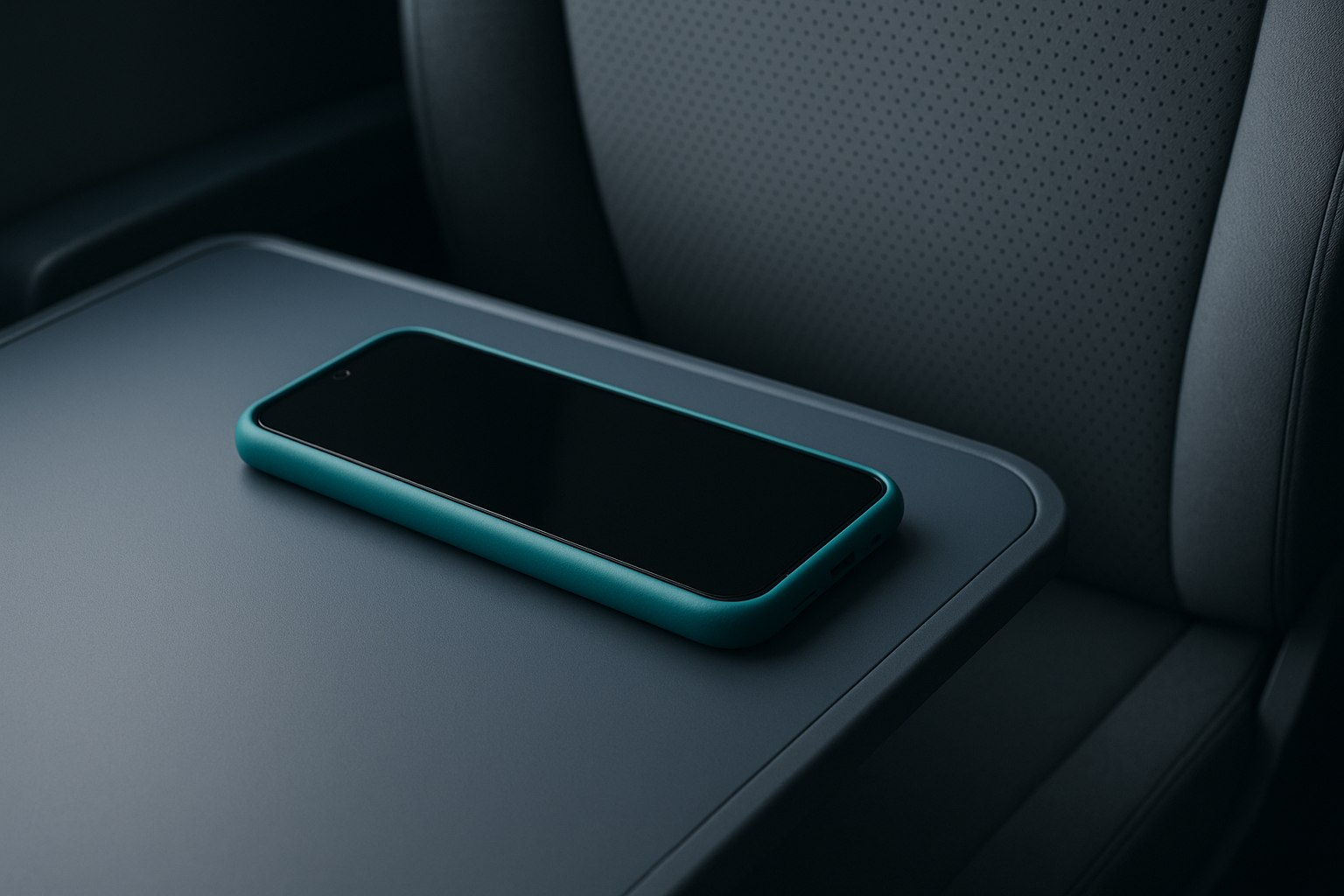
On a recent train ride, I experienced one of those moments you could dismiss as coincidence – but which, upon closer look, becomes a small design lesson.
I folded down the little tray table from the seatback, placed my phone on it, and noticed: the radius of my phone case fit perfectly into the rounded corner of the table. Millimeter precise.
You could say: “So what? Just coincidence.” But in fact, this observation tells an intriguing story about system design, standards, and invisible decisions that shape our everyday lives.
Radii – Small Curves, Big Impact
A radius might seem banal – just a quarter-circle on a corner. But in design, it carries huge significance:
- Ergonomics: A hard 90° angle cuts in. A soft radius invites touch.
- Safety: In vehicles, edges must be softened to reduce injury risk.
- Production: Certain radii are easier and cheaper to manufacture, whether through injection molding or CNC milling.
- Aesthetics: Rounded edges feel “friendly” and modern, sharp edges “precise” and strict.
The Train Table and the Phone Case
So why do two entirely different objects – a train tray and a phone case – share the same radius?
The explanation lies in a mix of:
- Standardization: European rail design rules prescribe or recommend radii to minimize injuries.
- Ergonomic experience: Designers know that certain curves “feel right” in the hand.
- Production & cost: Manufacturing tools follow standard measures – proven radii save money.
- Design logic: Product and vehicle designers alike use similar form languages: soft curves for touch surfaces.
System Design – The Invisible Order
This brings us to the core: system design. Objects don’t emerge in isolation – they are embedded in a web of standards, production methods, and user expectations.
The fascinating part: these systems often lead to the same solutions across entirely different industries.
From Theory to Everyday Life
That my phone case fits perfectly into a train tray is not a “secret master plan” between smartphone makers and the railway. It’s the result of invisible agreements: which radii feel comfortable, which processes are efficient, which standards ensure safety.
Why It Matters
We take for granted things that are the result of decades of refinement and alignment. A radius we barely notice is condensed industrial history. It connects two worlds – mobile electronics and rail travel – without them ever knowing each other directly.
Conclusion
A small moment on a train shows just how vast the field of design really is. It’s not just about pretty shapes, but about the invisible systems behind them. For me, that’s the quiet elegance of system design: creating harmony in our world without us noticing.