


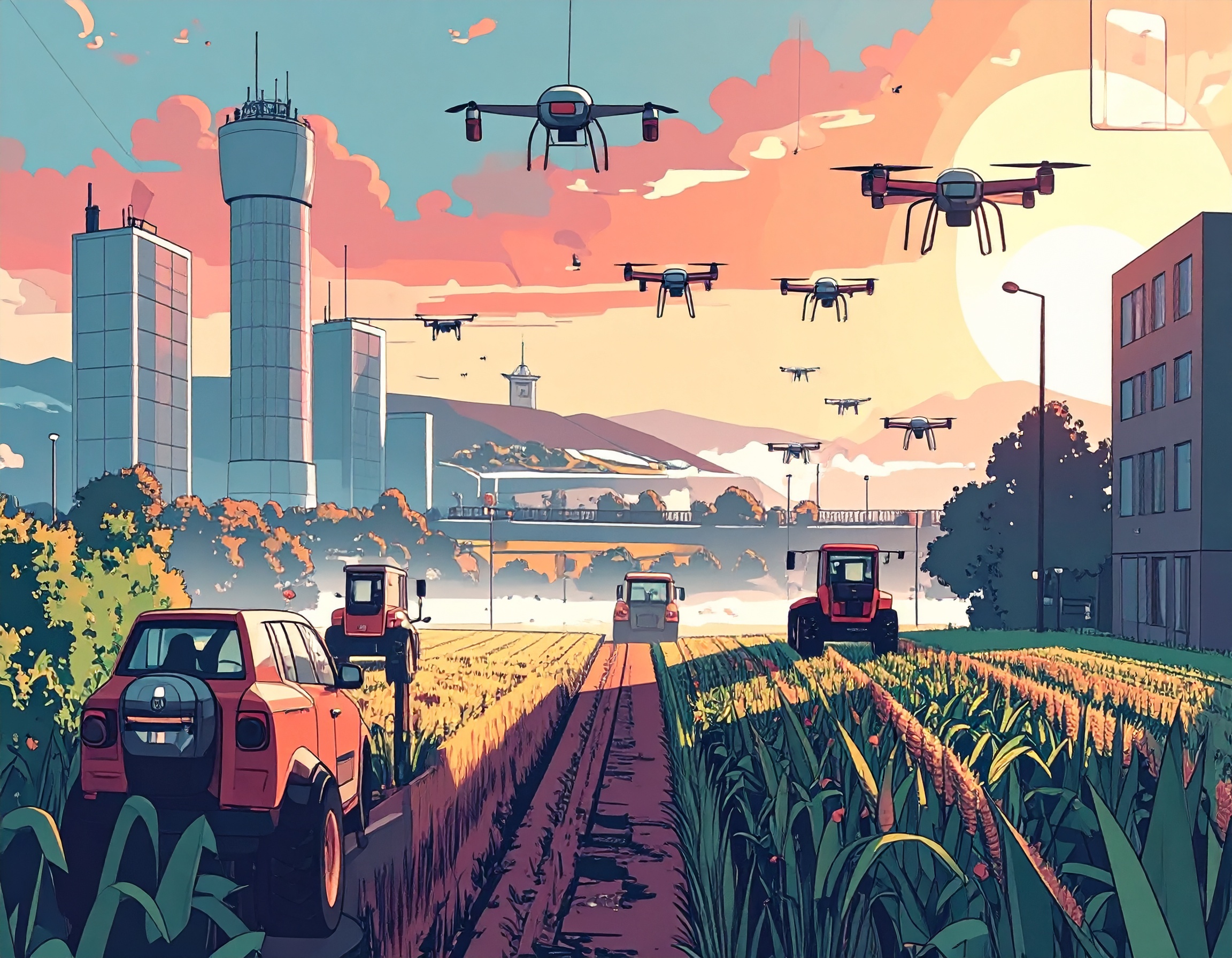
1. The fields aren’t empty – they’re connected.
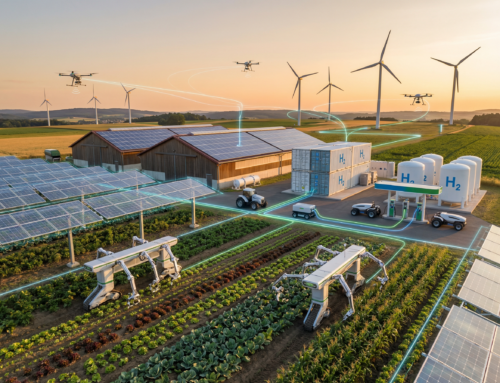
By 2035, tractors have become a rare sight.
The few that remain run on electricity or green ammonia.
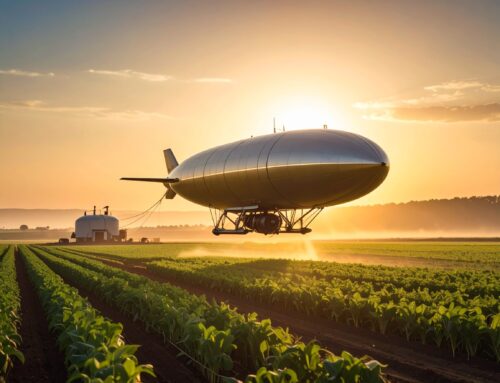
Drones – tethered or solar-powered – handle most of the seeding, fertilizing, and crop protection work.
Traditional field cultivation with heavy machines is gone – too much soil damage, too much CO₂.
Instead:
Light, autonomous swarms of robots work continuously and precisely.
They detect plant diseases earlier than any human.
They repair, sow, water, and harvest – modularly, like a living system.
Fields are no longer “areas,” but ecological networks of sensors, microclimate data, and AI-driven decisions.
2. Climate change as a constant – adaptation becomes a cultural technique.
Weather is no longer a coincidence; it’s a parameter.
Every region has its own climate signature.
In Brandenburg, heat-tolerant millet and lupins grow; in Lower Saxony, vineyards return.
Soils are no longer plowed but cared for – through greening, composting, and AI-supported soil moisture sensors.
New professions are emerging:
🪴 Soil Health Designer
🌦️ Microclimate Manager
📊 Agri-Data Steward
The classic image of the farmer as a machine operator is replaced by the farmer as an ecosystem architect.
3. AI as the silent partner
Artificial intelligence isn’t the boss – it’s the co-pilot.
It plans, simulates, and forecasts – from the optimal crop rotation to the best market timing.
It integrates climate projections, local biodiversity, and even social nutrition trends.
But:
AI must not decide who gets to eat – only how everyone can be fed.
Its contribution is ecological:
-
Minimizing losses through real-time harvest planning
-
Adapting crop varieties to regional microclimates
-
Globally coordinating production to prevent both overproduction and hunger
Across Africa and Asia, local AI nodes run on solar-powered servers, fueled by open-source agricultural data.
World hunger is not being fought with more land, but with more intelligence per square meter.
4. What has disappeared:
-
The diesel smell of tractors
-
Endless monocultures of wheat
-
Chemical air raids from above
-
Subsidies that send the wrong signals
5. What has emerged:
-
Nutrient loops: circular systems connecting city and countryside (bio-waste → fertilizer → food → city)
-
Vertical and rooftop farms as local suppliers
-
Digital gene banks: open, farmer-maintained seed databases
-
Food as local identity, not global commodity
6. The ethical question
By 2035, the most valuable resource is no longer oil or lithium – it’s trust:
in technology, in data, and in responsibility.
AI can help, but it needs human values.
Every algorithmic decision about seeds, water, or harvest remains transparent –
a principle called Transparent Agriculture.
7. Conclusion
Agriculture in 2035 is quieter, lighter, more local – and able to learn.
Humans remain the gardeners of the future – only now, with a co-pilot made of code.
*Foresight reflections on the occasion of the upcoming Agritechnica.