



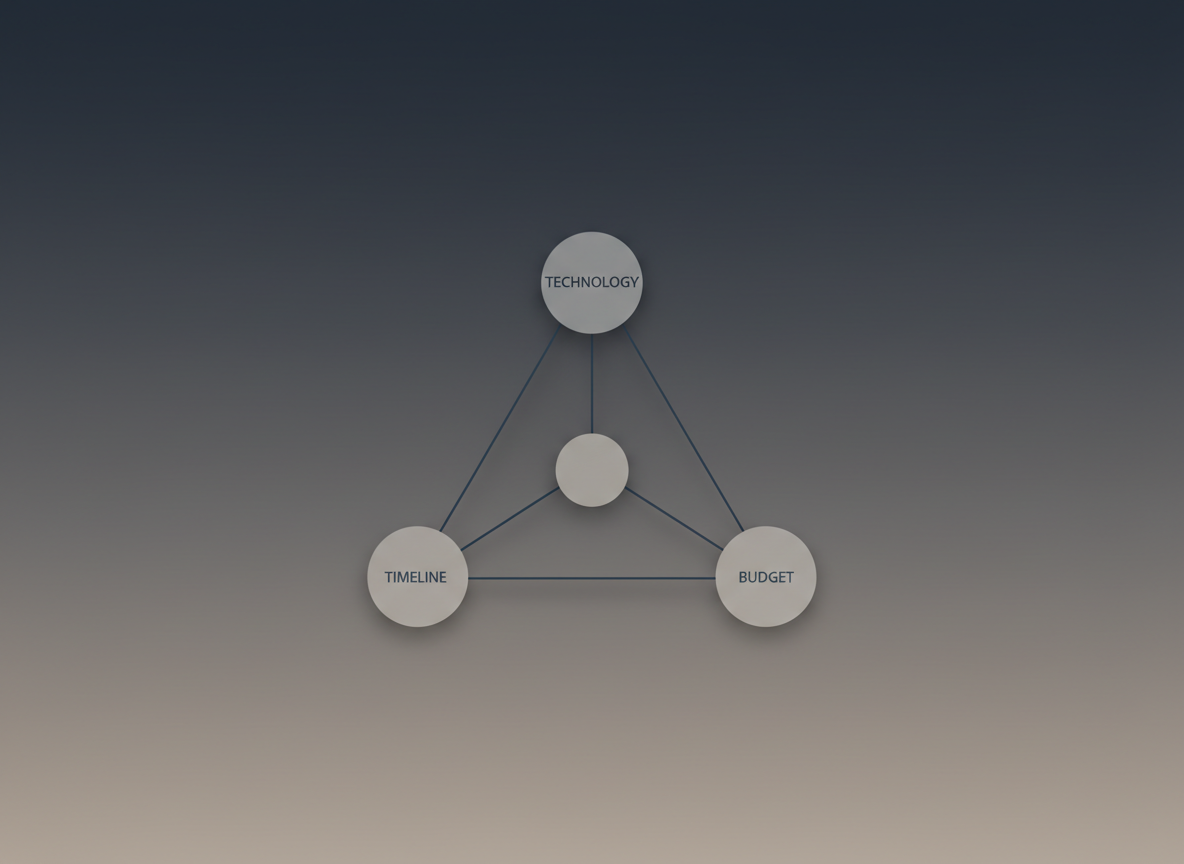
It Is a Decision.
Many capital goods do not fail in the market.
They fail earlier — in a moment that often goes unnoticed inside the organization.
It is the moment when decisions are postponed because they feel uncomfortable.
Or because there still seems to be time.
In this phase, design is frequently misunderstood.
As surface.
As a final step.
As something that is supposed to “help” once technology, timeline, and budget are already fixed.
In reality, design is one of the most effective instruments for making decisions visible, testable, and sustainable.
Not aesthetically.
But structurally.
Decisions Don’t Disappear — They Shift
Every product development process consists of decisions:
about structure, usability, materials, maintenance, transport, training, spare parts.
What is not decided consciously will be decided later by someone else:
-
by service teams under pressure
-
by users in moments of frustration
-
or by the market, irreversibly
Design cannot replace decision-making.
But it can expose it early.
The Critical Moment in Many Projects
Almost every capital goods project reaches a familiar point:
-
Engineering is confident in the technical solution
-
Sales looks for stronger arguments
-
Service raises first concerns
-
Management seeks certainty
Design is often expected to mediate between these interests.
Good design does not mediate.
It clarifies.
It forces priorities to be set.
It structures complexity.
And it challenges assumptions before they become expensive.
Why Early Design Reduces Risk
Many costs are not caused by design.
They are caused by late corrections.
A structured design process asks uncomfortable questions early:
-
What must the user truly understand?
-
What must never be seen?
-
What is allowed to age — and what must not?
-
Where is robustness more important than elegance?
These are not design details.
They are managerial decisions.
Those who make them early do not just save budget.
They reduce friction, loops, and internal conflict.
Products Communicate Attitude — Whether Intended or Not
Every product sends a message:
about how seriously users are taken,
about belief in longevity,
about the level of responsibility assumed.
Design translates this attitude into structure, form, and function.
Quietly.
But permanently.
Not in the showroom.
In daily operation.
Our Understanding of Design
pr-ide does not design surfaces.
We accompany decision processes.
We work where companies sense that they are approaching an important decision —
but clarity has not yet been achieved.
Good design does not begin with form.
It begins with the willingness to commit.
Because some decisions cannot be postponed.
They simply should not be made alone.



Leave A Comment
You must be logged in to post a comment.