



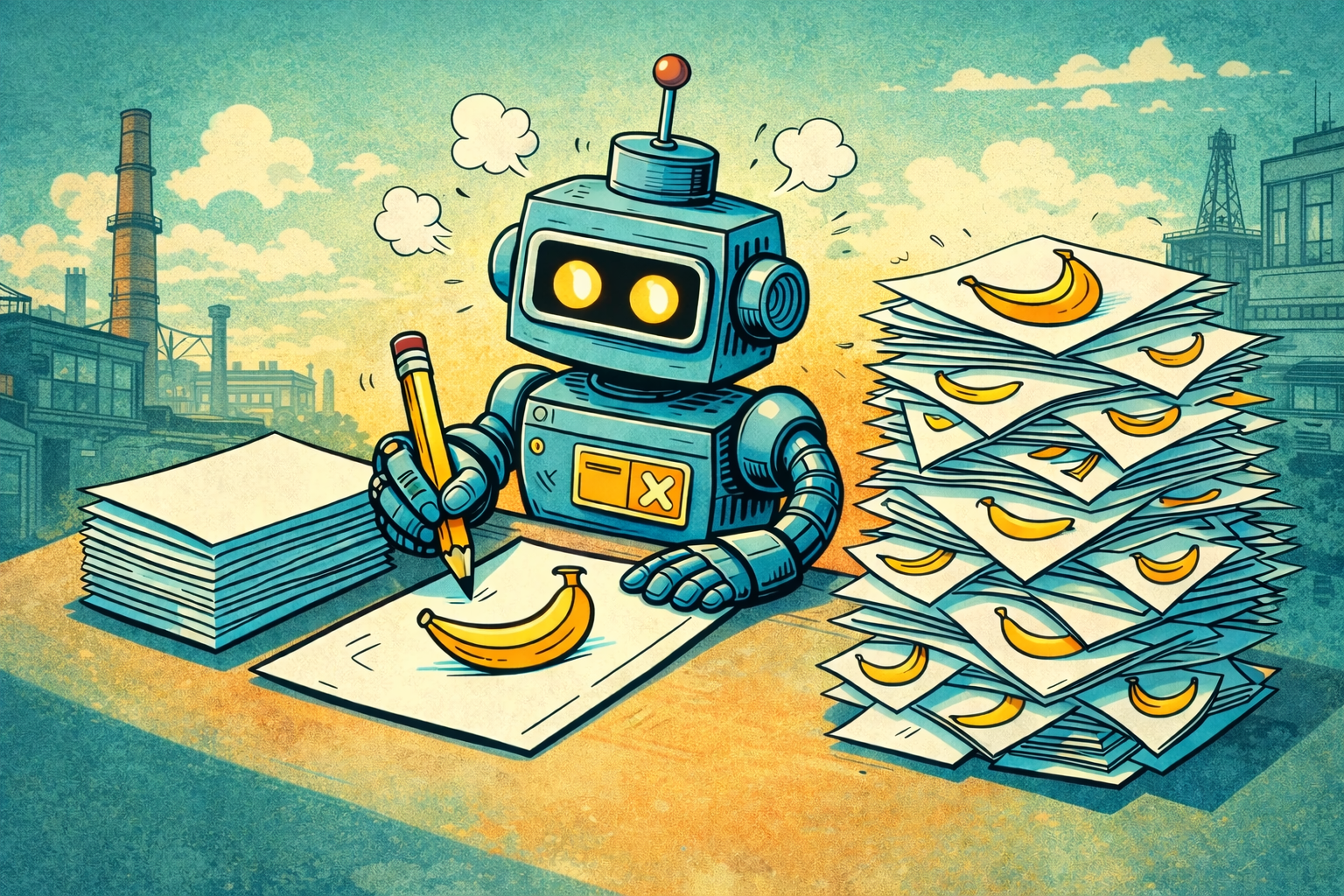
PaperBanana is the first system to automatically generate scientific graphics from text. Not as a gimmick, but as a complete pipeline: retrieval, planning, style selection, visualization, and quality control. This is impressive – and has implications that extend far beyond pretty diagrams.
The technology automates an area that previously existed at the intersection of subject matter expertise and design know-how: methodology diagrams. From now on, illustrations can be created as quickly as text. This saves time, ensures consistency, and makes publications more efficient.
But wherever AI creates structure, distortions always arise as well. This is precisely where the potential for failure lies.
1. Visual uniformity
When a system standardizes illustrations, individual styles of presentation disappear. The result is an academic Canva aesthetic: clean, homogeneous—but also monotonous.
Innovation in presentation becomes rarer because it no longer seems necessary.
2. Built-in historical prejudices
PaperBanana is based on existing diagrams from research.
This means:
Color conventions, aspect ratios, layout patterns – all Western-influenced.
The AI reproduces these norms unfiltered.
Old design patterns are reinforced instead of being questioned.
3. Semantic bias through interpretation
The pipeline “understands” the text and translates it into an image.
But understanding here is interpretation.
The result appears more precise than the text, even though it is only an AI reading.
It becomes dangerous where visual authority overrides technical accuracy.
4. Linguistic bias
The more precise the description, the better the diagram.
Such tools thus benefit people with:
strong English skills
academic vocabulary
clear descriptive structures
All others risk getting inferior visualizations.
5. Methodological bias
Exploratory, iterative, or qualitative research approaches are difficult to squeeze into modular diagrams.
PaperBanana prefers linear, structured, and technical designs.
What AI can draw well automatically appears more “scientific”.
6. Misinterpretation in Industry & Documentation
In companies, automation could lead to a dangerous pattern:
“The diagram looks professional, so it must be correct.”
However, AI can represent technical details incorrectly, incompletely, or in an oversimplified way.
The risk arises primarily where people trust visual representations more than text.
Conclusion
PaperBanana is a milestone in automation.
It will accelerate research, standardize publications, and reduce the workload for teams.
At the same time, it shifts power from images to text—and thereby entrenches new forms of bias.
The challenge lies not in using the tool, but in dealing responsibly with its effects.
Automation makes many things easier.
But it also changes the way we communicate science.
We should consciously shape this change – not leave it to the algorithm.



Leave A Comment
You must be logged in to post a comment.