



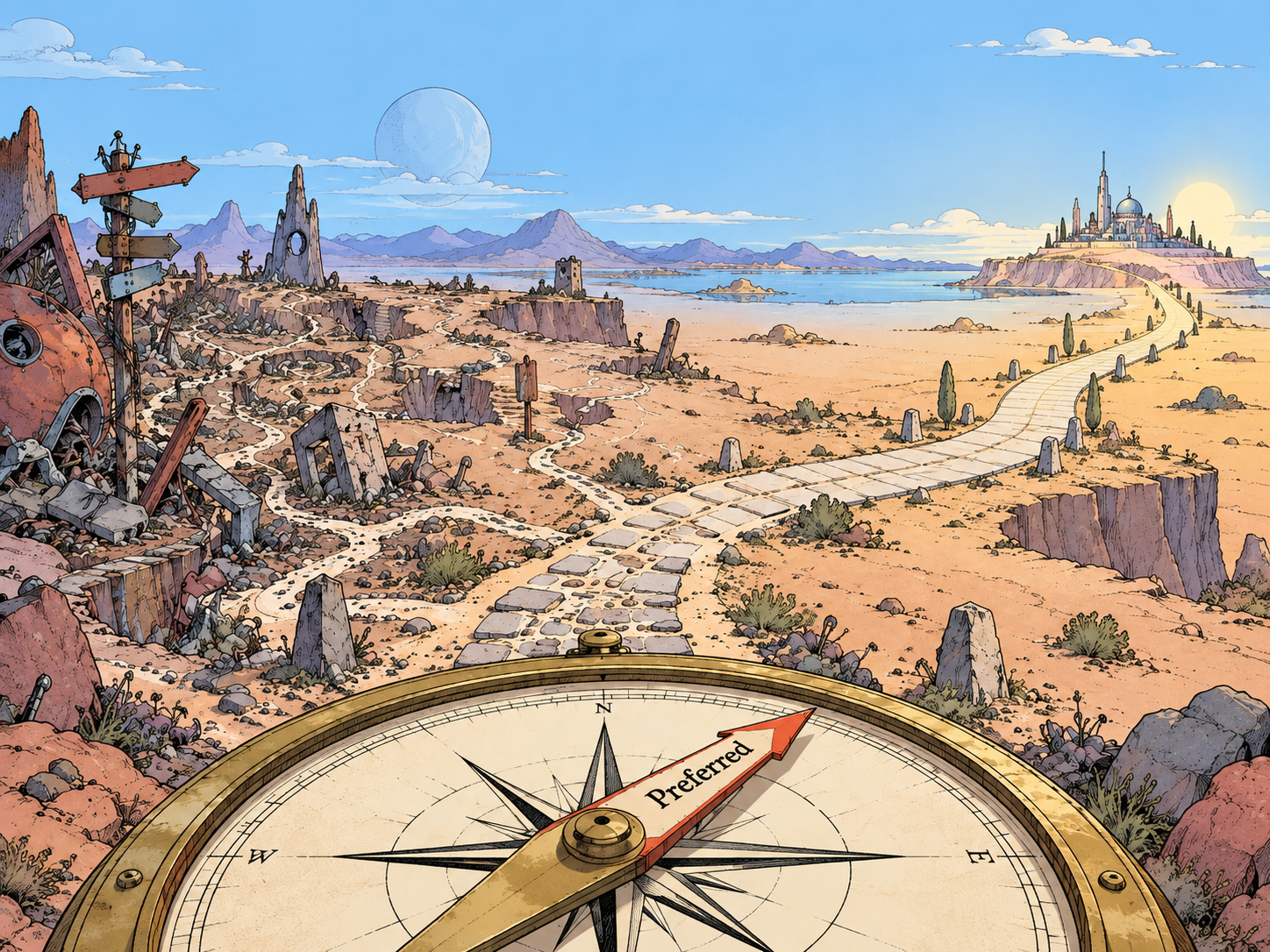
An idea from Herbert Simon that’s nearly 60 years old—and why it seems surprisingly relevant today.
I’ll admit it: With the now countless articles about how AI is changing work, design, and leadership, I often find myself scrolling past them pretty quickly these days.
Still, I recently found myself drawn to an article by Anne Kurth.
Not because of AI. But because of a quote by Herbert Simon.
In her article on design leadership, Anne Kurth referred to Simon’s 1969 book, *The Sciences of the Artificial *. In it, Simon describes design, in essence, as the development of courses of action that transform existing situations into desired ones.
I had read Simon’s work many years ago. And as I was reading her post, that thought suddenly came back to me.
This is because this definition of design is considerably broader than what is commonly understood by the term in everyday life.
Design is more than just the creation of products
As an industrial designer, you’re used to thinking about design in very concrete terms at first.
How does a product work?
How is it used?
How is it made?
Why is it taking so long?
How much are you willing to spend?
How does it look?
And how do you strike a reasonable balance among all these requirements?
The result can be a machine, a tool, a vehicle, or a digital interface.
According to Simon’s definition, however, the object itself is not the crucial point.
What matters is the change in a situation.
There is the current state of affairs. There is a vision of how the situation could be improved. And in between lies a plan.
To put it simply:
ACTUAL → Design → TARGET
This suddenly allows us to see much more than just design.
We design products.
But we also design workflows, services, communication, decision-making processes, and organizations.
And that puts you in the lead surprisingly quickly.
Leadership as a Design Task
After all, a leader also shapes situations.
Who attends a meeting?
Who speaks first?
What information is available?
Who gets to decide?
What goals are set?
What options are available?
And how is success measured?
Much of this seems to happen naturally in the course of our daily work.
But “of course” doesn’t mean “neutral.”
Seating arrangements influence communication. An agenda sets priorities. A reporting system helps determine what gets noticed in the first place. And an organizational structure determines who talks to whom—and who may never speak to one another.
This turns these things into structured frameworks.
From this perspective, leadership would therefore be less a matter of:
How can I get people to do something specific?
Rather:
What conditions do I need to create to enable good decisions and meaningful actions?
That’s very similar to what designers do.
Designers rarely choose between perfect solutions
In design, there’s almost never just one right answer.
A solution must be technically viable, manufacturable, cost-effective, meet user requirements, comply with safety standards, and—ideally—still embody a clear design concept.
These requirements often contradict each other.
The art of design does not lie in optimizing a single aspect to the utmost. It lies in developing a viable design from conflicting requirements.
This idea can also be found in Herbert Simon’s work.
With his concept of ” bounded rationality,” he has described how people generally make decisions under limited conditions: with incomplete information, limited time, and limited processing capacity.
So we rarely compute the theoretically perfect solution.
We are looking for a solution that works under real-world conditions.
To an industrial designer, that sounds very familiar.
And the same goes for leadership, really.
The key word is “preferred”
However, there is one word in Simon’s definition that I find particularly interesting:
preferred.
The goal is to transform the current situation into the desired situation.
This inevitably raises the question:
Requested by whom?
- From the company?
- From the employees?
- From the customers?
- From the market?
- From society?
- Or by those who currently have the power to make a decision?
At this point, design becomes more than just problem-solving.
It becomes a responsibility.
After all, design doesn’t just determine how something is changed.
It often also plays a role in determining what is considered an improvement in the first place.
This applies to products as well as to organizations.
A product that can be manufactured more quickly may be more economical. Does that make it better?
A process that becomes more efficient may save time. For whom?
An organizational structure can speed up decision-making—while at the same time reducing participation.
Design is therefore never completely neutral.
And then comes AI
Maybe that’s also why I find Simon’s thoughts on the current AI debate so interesting.
We talk a lot about what AI is now capable of creating.
Images. Texts. Concepts. Variations. Analyses. Designs.
And that is undoubtedly impressive.
But generating a hundred or a thousand variations still doesn’t answer the real question.
What kind of situation are we actually trying to achieve?
Or, to put it another way:
- AI can be very helpful in exploring possible approaches.
- But someone has to decide where these paths should lead—and why.
- That is precisely why, in my opinion, AI does not automatically make design any less relevant.
- It’s possible that the focus is simply shifting.
- Moving away from simply creating variants.
Toward understanding connections, setting goals, assessing consequences, and making informed decisions.
That, in turn, would be quite close to Simon’s concept of design from 1969.
Maybe we’re designers much more often than we realize
For me, Anne Kurth’s contribution was therefore a wonderful opportunity to bring Herbert Simon back into the spotlight. His definition makes design more than just a job title.
According to this view, design would be a specific way of acting:
- Understanding a given situation.
- Describe a possible, better scenario.
- And develop a path that leads from one to the other.
Industrial designers do this with products.
Service Designer with a focus on processes.
Organizational developer with a knack for structures.
And managers with the conditions under which people work and make decisions.
The tools are different.
The fundamental task, perhaps, to a lesser extent.
Thanks to Anne Kurth for the food for thought—and for reminding me of a text that I obviously should read again after a few years.
Source / Further Reading
Herbert A. Simon: *The Sciences of the Artificial*, MIT Press, first published in 1969.
This post was inspired by a LinkedIn post by Anne Kurth on the topic of design leadership.
→ https://lnkd.in/p/dGB3-J3V


Leave A Comment
You must be logged in to post a comment.