



A machine can make work processes significantly easier. For this benefit to influence a purchasing decision, it must be clear to the prospective buyer. When it comes to time savings in particular, it depends on the specific operation: What tasks need to be done, how often do they recur, and how much time do they take overall?
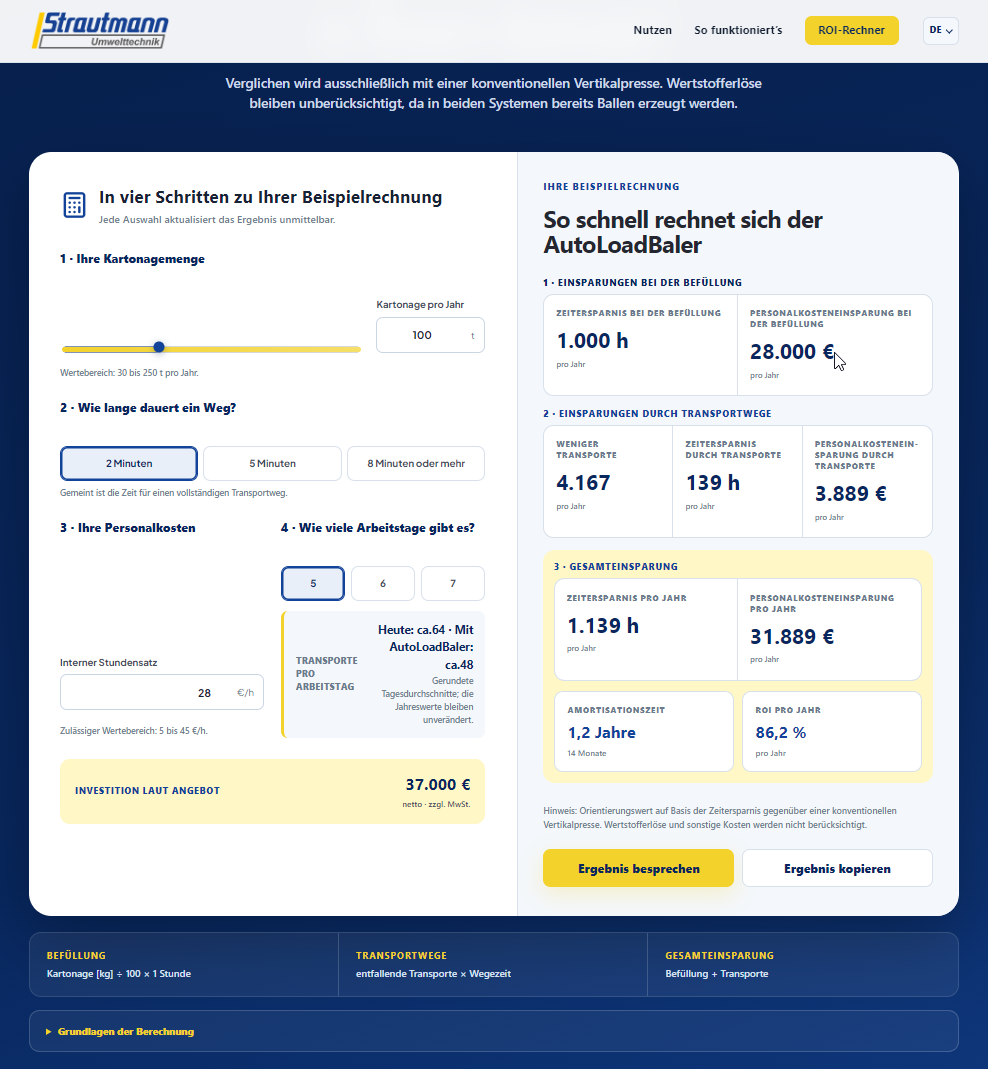
At pr-ide, we developed an online ROI calculator for Strautmann Umwelttechnik that illustrates this relationship. Using the AutoLoadBaler as an example, users can estimate how changing the way cardboard is handled can affect the time required and overall cost-effectiveness. The calculator is now available on the Strautmann website.
In many businesses, disposing of cardboard is part of the daily routine. Packaging is collected, taken to the baler, and loaded into it. Each individual step seems manageable. Over the course of a workday, a week, and ultimately a year, however, this adds up to a considerable amount of work.
The AutoLoadBaler comes into play at this stage of the process. Cardboard is loaded into collection carts, which are then fed into the machine. The automatic loading process allows employees to focus on other tasks. The benefit, therefore, also lies in the organization of work around the machine.
This presents a specific challenge for our communications: How do we convey this benefit in a way that allows a prospective customer to relate it to their own daily work routine?
A general statement like “saves time and money” leaves a lot open to interpretation at first. A market with a high volume of cardboard packaging has different requirements than a smaller location. Today’s transportation routes and projected labor costs also influence the economic value that time savings can provide.
Our approach was to use these operational differences as a starting point. The user enters information about their situation and receives an assessment based on that information. This allows them to explore for themselves which factors influence the result.
The calculator converts data such as material quantities, time required, and internal hourly rates into a representation of the potential benefits. It shows how much working time can be saved in theoretical terms, what value that time has, and how it contributes to the payback of the investment. By changing the input values, you can run through different scenarios. The results serve as a guide based on the specific data and calculation methods provided. :chatgpt-content-reference{index=”1″}
For us, this is a design challenge that begins with the structure. What information does the user need to make an initial assessment? In what order does it make sense to present this information? Which terms are easy to understand? And how can multiple numbers be transformed into a result whose meaning can be grasped quickly?
The user interface must balance two requirements: an easy learning curve and sufficient transparency to allow users to understand the result. Every additional input requires attention. At the same time, the variables that are critical to the calculation must remain clear. This trade-off shapes both the conceptual design and the visual design.
Presenting the results also requires care. The time saved has economic value. How this translates into tangible benefits for the business depends on how the freed-up capacity can be utilized. For example, it can help absorb work spikes, reduce overtime, or provide more time for customers and other tasks. A reported time value can therefore also be understood as available leeway.
Such a tool can also help prepare for the consultation. Prospective customers are already familiarizing themselves with their material volumes and processes. During the subsequent discussion, these details can be refined and aligned with the site’s specific requirements. This provides the sales team with a common starting point from which to proceed.
This project brings together several areas of our work at pr-ide: understanding technical products, translating their benefits into clear communication, and designing a digital application.
At pr-ide, we view technical products from the perspective of the people who use them. We’re interested in which tasks become easier, where the workload is reduced, and how workflows can be improved. This understanding shapes our design and product communication. In the case of the ROI calculator, it forms the basis for a tool that allows prospective customers to estimate the potential benefits for their own business.
You can try out the calculator here:
Go to the AutoLoadBaler ROI Calculator from Strautmann Umwelttechnik




Leave A Comment
You must be logged in to post a comment.